Have you ever opened so many browser tabs while researching a business tool that you couldn’t even see the titles anymore?
I recently found myself doing exactly that. Ironically, the more research I did, the harder the decision became.
In this month’s issue of UpFront & Center, I share a simple strategy that helped me break out of analysis paralysis and regain momentum.
Sometimes the best way forward isn’t more options.
It’s fewer.
Center Stage
Just last week I was researching CRM platforms (Customer Relationship Management). I was utilizing “all the things” — the program reviews, feature comparisons, asking for feedback from my friends. I transferred all this information to my own spreadsheet trying to make sense of it all. I drove myself batty.
The tabs just kept multiplying.
At one point my screen looked like this:
- CRM comparison spreadsheet
- YouTube product review
- Pricing pages
- Reddit opinions
- Two tools I hadn’t even heard of the day before
And somehow the decision felt farther away—not closer.
Despite all the research, I still couldn’t decide which tool to choose.
One of the unexpected challenges of building a business hasn’t been the work itself—it’s been the decisions.
As I evaluated CRM options, every platform promised to be the perfect solution—more features, more integrations, more customization.
And the more options I explored, the harder the decision became.
Eventually I did what many of us do when choices feel overwhelming.
I froze.
The irony was that all the research I thought would help me decide was actually making the decision harder.
Decision fatigue—sometimes called analysis paralysis—happens when overthinking and too much research prevent us from moving forward.
The result is often inaction or missed deadlines.
Behavioral psychologist Sheena Iyengar studied this phenomenon in her well-known “Jam Study.”
When people are presented with too many options, they are significantly less likely to make a decision at all.
How many tabs are open in your browser right now?
If you’re like most entrepreneurs and solo professionals, the answer might explain a lot.
The Point
Too many options don’t always create better decisions.
Often, they create delayed decisions.
Reducing choices can reduce stress, sharpen focus, and help restore momentum in your business.
Sometimes progress doesn’t come from more research—it comes from making the next reasonable choice and moving forward.
Small decisions quietly shape the momentum of progress.
The Takeaway
If you find yourself stuck in research mode with dozens of browser tabs open, try this:
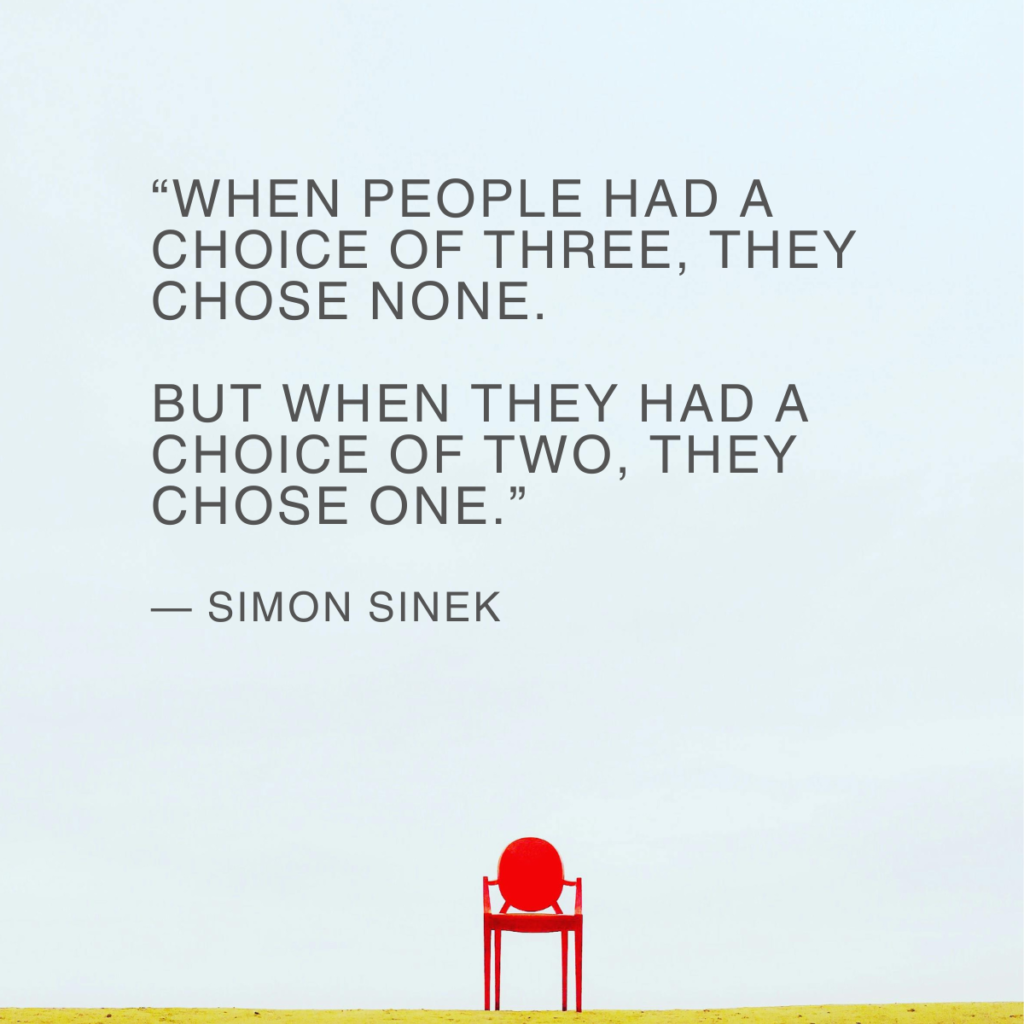
Reduce your options to two.
You may find that the decision becomes far easier—and the momentum you gain will carry you forward.
Sometimes less choice truly leads to more progress.
- Decision precedes direction.
- Direction precedes momentum.
- Momentum precedes results.
A Quick Win
When evaluating tools, systems, or strategies, narrow the options down to two choices.
At that point, the question shifts from “Which one is the absolute best?” to “Which one do I prefer right now?”
That simple shift removes a surprising amount of mental friction and helps momentum return.
I call this the Two-Option Decision Framework—a simple process that moves you forward.
research → decision → momentum
Sometimes the fastest way forward is simply reducing the noise.
If you’d like to try it yourself, I created a one-page checklist you can use whenever you’re evaluating a new tool or system.
👉 Download it here: Two-Option Decision Framework
Center Challenge
I’d love to hear from you.
Is there a system, tool, or process in your business—or even your volunteer work—that’s been frustrating you lately?
Reply here or leave a comment below and tell me about it.
I will research a solution and possibly feature it in a future issue of UpFront & Center so others can benefit as well.
Take it UpFront
If sorting through systems, tools, or processes in your business feels overwhelming, oftentimes an outside perspective can bring the clarity you need.
If you’d like help simplifying your business systems, you’re always welcome to schedule a conversation with me.
Until next time,
Keep moving forward — and keep what matters UpFront.